
A Decade Plan for the Post-Labor Transition
Based on Shapiro’s Universal High Income Framework

The Governing Logic
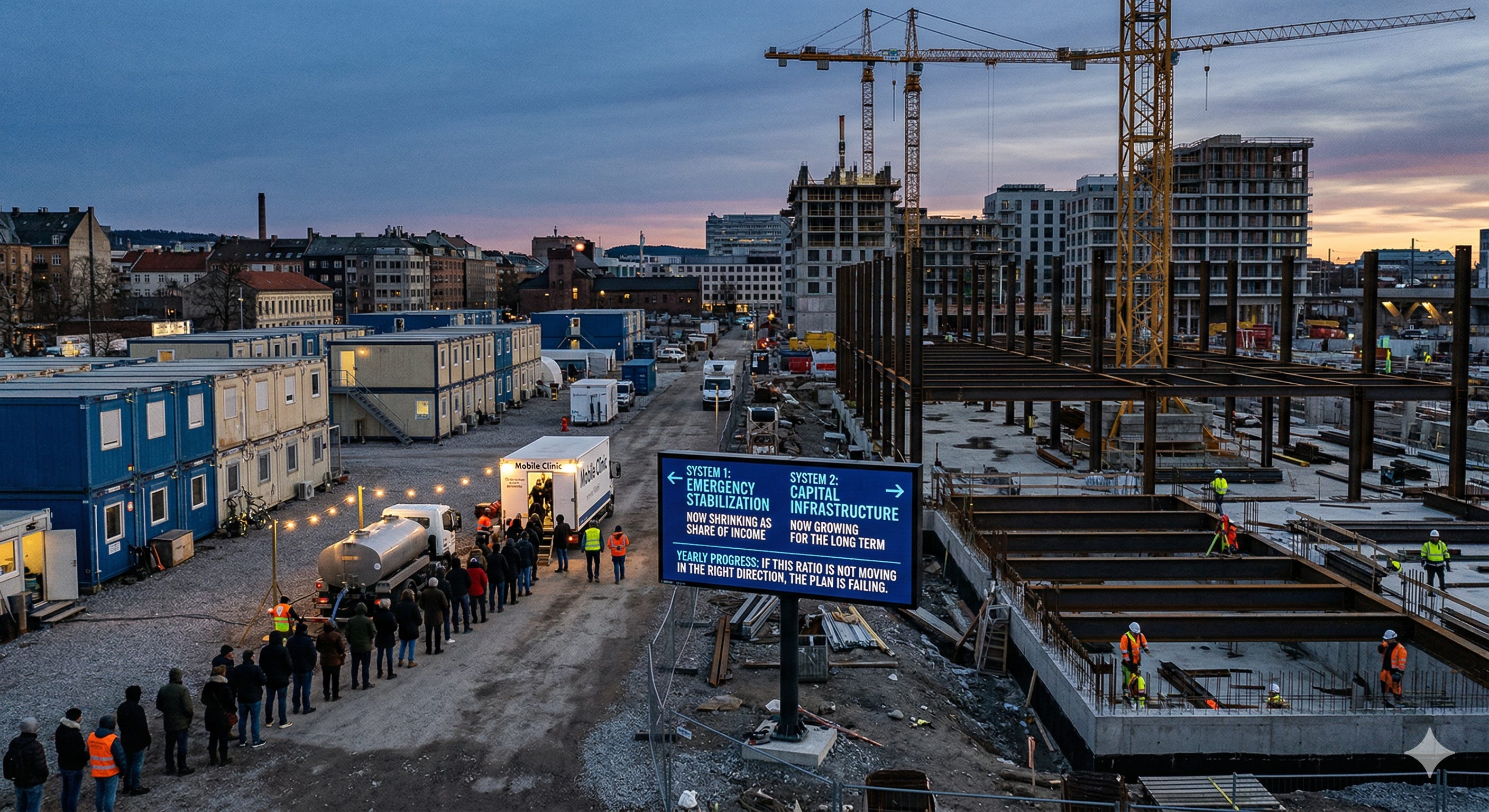
You cannot build the permanent architecture fast enough. So you run two systems in parallel: emergency stabilization now, capital infrastructure for the long term. Every year, the emergency system should shrink as a share of household income, while the capital system grows. If that ratio is not moving in the right direction, the plan is failing.
Phase One: 2025 to 2027 — Stabilize the Floor
The labor market is already wobbling. This phase buys time and builds political legitimacy.
What you do
Expand and consolidate existing transfers immediately. Merge SNAP, TANF, EITC, and the Child Tax Credit into a single monthly cash payment administered by SSA. No new bureaucracy. Redirect existing spend. The goal is a functional Transfer Floor by the end of 2026.
Pass an Automation Dividend Tax. A modest levy on firms deploying AI and robotics above a threshold of displaced workers. Revenue goes directly into a ring-fenced National Transition Fund, not into general revenue, where it disappears.
Mandate data royalty frameworks. Establish the legal foundation that personal data is a commons. Major platforms begin accruing royalty obligations. Payment structures are set for Phase Two.
Launch Baby Bonds at the federal level. Every child born after January 1, 2026, receives a capital endowment at birth. Start at two thousand dollars. The compounding has to start now because it takes twenty years to matter.
What you measure
- Percentage of households with a cash floor in place
- Automation Dividend Tax revenue accumulating in the Transition Fund
- Baby Bond enrollment rate

Phase Two: 2027 to 2030 — Build the Capital Architecture
Stabilization is holding. Now you build the permanent structures.
What you do
Establish a federal Sovereign Wealth Fund seeded by the National Transition Fund and new VAT revenue. Initial capitalization target: $ 500 billion. Begin distributing modest annual dividends per citizen by 2030. Small at first. The psychological shift of receiving capital income matters as much as the dollar amount.
Enact the Revenue Pivot legislatively. Phase in a 10 percent VAT. Introduce carbon pricing with a dividend component. Eliminate the stepped-up basis at death and the pass-through deduction. Shift payroll tax obligations toward automation taxes as the labor base contracts. This is the hardest political lift of the decade. It requires a coalition that does not currently exist.
Aggressively expand ESOP and cooperative tax incentives. Make worker ownership the path of least resistance for business succession. When a business owner retires, the easiest exit should be selling to the workers.
Launch state-level Sovereign Wealth Funds with federal matching. Alaska’s Permanent Fund is the proof of concept. Scale it nationally, using commodity royalties, data royalties, and carbon revenues as primary inputs.
Begin paying data royalties. The legal framework from Phase One starts generating actual cash transfers to citizens. Small amounts initially. The principle is established.
What you measure
- Federal SWF capitalization trajectory
- VAT revenue replacing payroll tax revenue as a percentage
- ESOP adoption rate among mid-size businesses
- Dividend payment per citizen from state and federal funds

Phase Three: 2030 to 2033 — Close the Automation Cliff Gap
This is the danger window. AI displacement accelerates. Capital programs are growing but not yet mature. Emergency transfers must be thick.
What you do
Increase the Negative Income Tax Credit floor to keep pace with displacement. This is not optional. Aggregate demand collapses without it. The Transition Fund absorbs the cost.
Accelerate Baby Bond contributions for children born between 2025 and 2030. They are still years from maturity. Supplement with direct transfer top-ups for families in displaced sectors.
Expand Universal Basic Services. Healthcare is fully decoupled from employment. Community college and vocational retraining are free and aggressively marketed. Public transit expanded in displacement-heavy regions. Every service you universalize reduces the cash floor required.
Launch DAO and decentralized ownership pilots. Select municipalities pilot tokenized ownership of local infrastructure, utilities, and services. Citizens receive micro-dividends. The model is tested at a small scale before replication.
What you measure
- Labor force participation rate by sector
- Household income composition: wages versus transfers versus capital
- Transfer dependency ratio: is it stabilizing or still growing?

Phase Four: 2033 to 2035 — Portfolio Income Becomes Normal
By this point, a household income built from multiple capital streams should be visible and measurable for a significant portion of the population.
What you do
SWF dividends reach meaningful levels. The target is $500 to $1,000 per citizen annually from combined state and federal funds by 2035. Not enough to live on alone. Enough to be real.
Baby Bonds begin maturing for the oldest cohort. The 2025 birth year reaches ten years of compounding. Begin structured drawdown options tied to education, business formation, or housing.
Automate and simplify the full income stack. A citizen’s monthly income statement should show: Transfer Floor payment, SWF dividend, data royalty distribution, EITC or NIT credit, and any wage income remaining. One dashboard. One system. SSA administers the full portfolio.
Begin unwinding emergency transfers as capital income rises. The ratio must move. Track it publicly and legislate automatic adjustments tied to the household income composition data.
What you measure:
- Per-citizen capital income from all sources combined
- Percentage of households where capital income exceeds 20 percent of total income
- Reduction in emergency transfer spending as capital income rises
The Political Reality
None of this is technically complicated. The mechanisms exist. The obstacles are three.
First, incumbent capital does not want its tax advantages eliminated. The Revenue Pivot is a direct reallocation from concentrated wealth to distributed capital. It will be fought hard.
Second, the timeline mismatch is brutal for elected officials. Baby Bonds mature in twenty years. Politicians run on two- and four-year cycles. The payoff is invisible to the people who have to vote for it.
Third, the public narrative is not ready. Most people still believe that work is the only legitimate source of income. That belief has to change before the policy can. The cultural work runs alongside the legislative work, not after it.
The Single Sentence Version
Tax the machines and the data, give every child capital at birth, build sovereign funds that pay dividends, keep the floor thick while you wait for it all to mature, and never stop reminding people that the economy is a shared inheritance, not a private game.

Credit to Shapiro
“The 8 Building Blocks of Universal High Income” at daveshap.substack.com, published just two days ago (March 28, 2026). (Substack)
His broader body of work lives at daveshap.substack.com, with supporting essays going back to late 2023.
He also has a book, Labor/Zero: A Post-Labor Economics Treatise, approximately 180,000 words with hundreds of citations, which he narrated himself as an audiobook. It launched on Kickstarter and includes a UHI simulator. (Substack)